
What Is a Pulmonary Nodule? Is It Lung Cancer?
A pulmonary nodule is that dreaded “spot” seen on a chest CT scan, and it can mean anything from an old scar to lung cancer. Most pulmonary nodules are not cancer. They can be caused by old infections, inflammation, scar tissue and many other things. But because an early lung cancer can also appear as a nodule, the important question is not simply, “Do I have a nodule?” It is, “How likely is this particular nodule to be cancer, and what should we do next?”
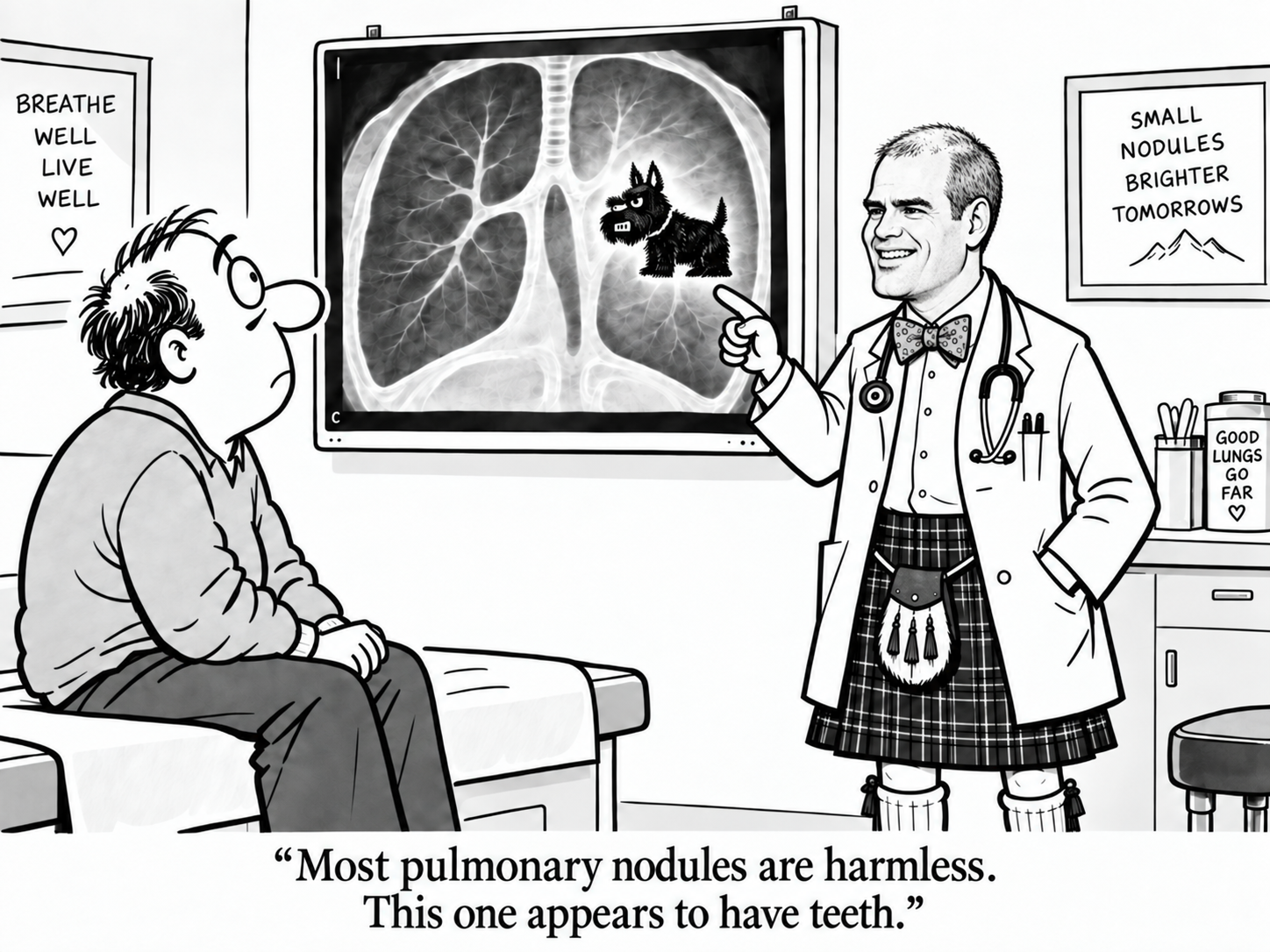
Not all nodules carry the same risk. Some have features that make cancer very unlikely. A calcified nodule has usually been there a very long time and has basically turned to stone.
Time matters too. A solid pulmonary nodule that has not changed for two years is generally accepted as benign by convention. Non-solid, or ground-glass, nodules are different. They usually grow much more slowly, so we watch them longer. For many ground-glass nodules, five years without change is the conventional endpoint for routine follow-up.
If none of those reassuring things are true, the next rule is don’t panic. A nodule that is not obviously benign is still a long way from automatically being cancer. In the National Lung Screening Trial (NLST), even among people at high risk for lung cancer, only about 1% of pulmonary nodules were cancer.
So now the job is to figure out how worried we should be and what makes the most sense to do next.
At first, that means looking at three things together: your risk for lung cancer, whether you have symptoms that raise concern, and the size of the nodule.
Your age, smoking history, prior cancer, exposure to certain toxins, some medical conditions and other risk factors all change the odds. This is also a good time to make sure you are up to date with the other cancer screening recommended for your age and risk.
Symptoms matter. If you have symptoms or imaging findings that suggest infection or inflammation, it may make sense to treat that problem first and repeat the CT in a short period of time to see whether the nodule gets smaller or disappears. Other symptoms may make us more suspicious and speed up the evaluation.
And size really matters. In general, the larger the nodule, the greater the chance that it could be cancer. Small nodules under 8 mm are both less likely to be cancer and very difficult to biopsy accurately. Unless one is increasing in size or has other worrisome features, the safest and smartest next step is often another CT rather than rushing into a biopsy.
A pulmonologist, especially one who spends a lot of time evaluating abnormal chest CT scans and lung cancer, can make a plan with you that balances the risk of missing something important against the risks of unnecessary scans, biopsies and procedures.